A $12 Candle Wrapped by Hand Says More Than a $200 Bouquet—How Thoughtfulness Quietly Outranks Price in the Language of Love.
This report is based on insights from 5 in-depth interviews covering a diverse group — including young couples in relationships, married couples, and singles (ages 25-35) distributed across different regions of the United States. Through systematic analysis of respondent backgrounds, gift-giving behavior in intimate relationships, Valentine's Day consumption attitudes, views on holiday limited-edition products, and ritual needs across five dimensions, this report aims to answer: How do young American consumers view Valentine's Day marketing? Does the limited-edition concept truly drive purchase decisions? What emotional value do gifts carry in intimate relationships? And how do ritual needs influence their consumption choices?
Respondents' daily life circumstances and consumption habits reflect different understandings of quality and ritual. Some enhance life quality through purchasing specific product categories (such as self-care products or home décor), while others prioritize functionality and practicality, rarely buying "ritual-enhancing" products for themselves. These differences are closely tied to their relationship status, lifestyle, and overall attitude toward consumption.
"I would probably say, like, self care items. Probably, like, candles or bath bombs or shower steamers."
— Kayla Gibson
"You use them to make yourself feel good."
— Kayla Gibson
"Yes. I do. Actually, I I choose sometimes I'll get myself a really nice face scrub or just some really nice shampoo just because I, you know, I feel like sometimes I deserve something a little special. Even in my everyday."
— Landon Whisnant
"Yeah. It's gift giving for me. It's just like for myself, I'm buying, like, the cheapest things that work. I'm I'm looking for efficiency. I'm looking for practicality for myself."
— Katie Wilson-Barge
"Yes. The the decorations that I get."
— Kayla Gibson
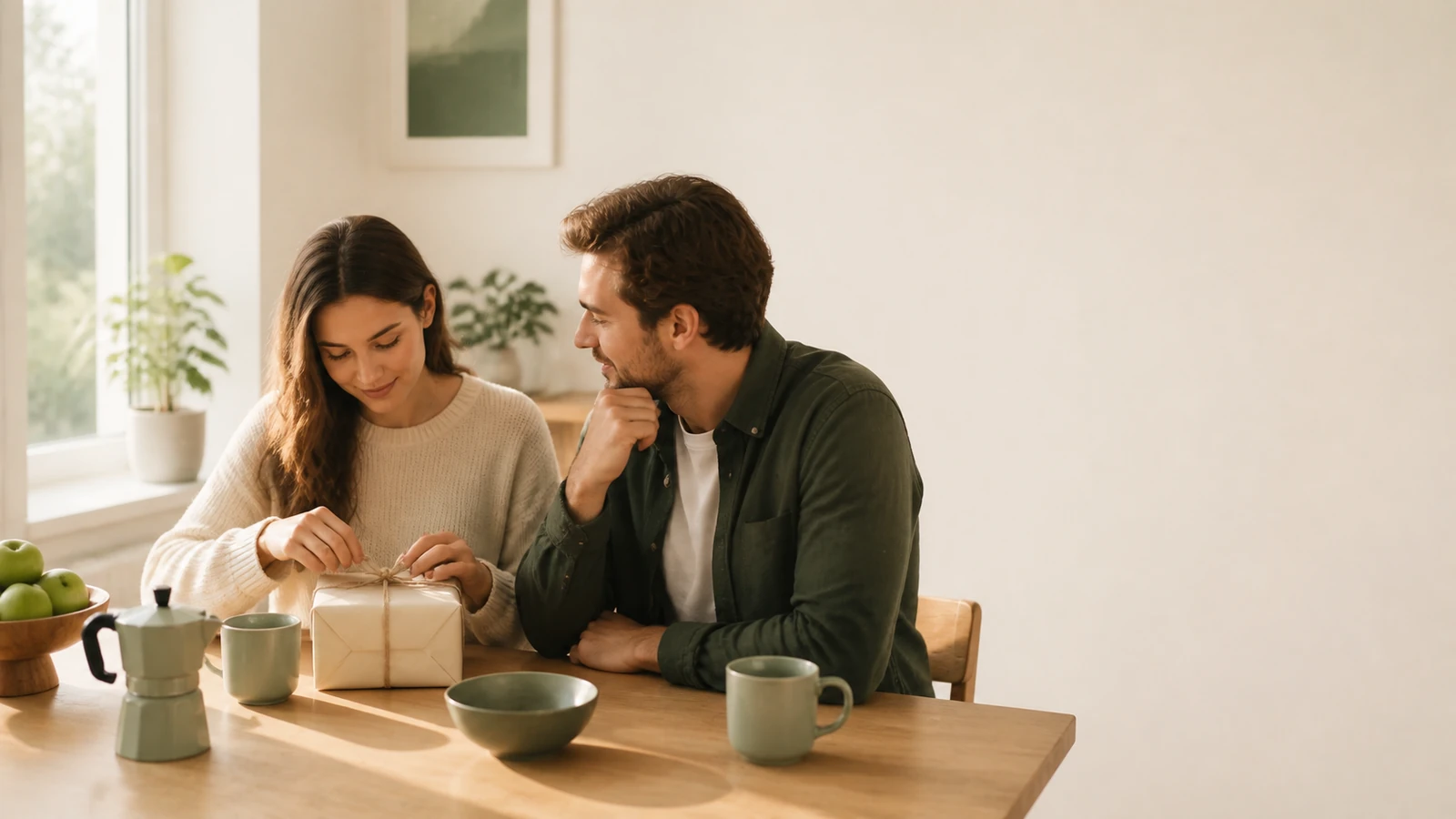
When discussing gifts in intimate relationships, respondents universally emphasized the emotional meaning gifts carry and how well they demonstrate understanding of their partner, far exceeding gifts' material value or price. The gift selection process involves deep observation of partners' preferences, needs, and lifestyle, with successful gifts often solving partners' practical problems or echoing their long-term interests. Respondents' definition of a "good gift" focuses on practicality, personalization, and whether it reflects the giver's thoughtfulness.
"Something that'll make him happy."
— Kayla Gibson
"Yeah. I got a partner a mug warmer. So it's something where you can maybe make tea and set it on this little warmer, and the warmer keeps the mug warm. It keeps your tea warm. Right? Whether that's tea, hot chocolate, coffee, etcetera. Right? I knew that that was something she, like, based on, you know, she likes to drink, would drink tea a lot. She would drink coffee a lot and needed something to keep it warm. Had mentioned all, you know, her coffee or her tea would get cold. So then I knew, oh, this was something simple I could get to make that experience more fun for her."
— Adam Brunner
"More on the useful thing with a flare for some fun. So the fun would be incidental and the useful would be the primary purpose."
— Adam Brunner
"Gosh. Sometimes I'll get them fun things. I'm struggling around this. Sometimes I'll get them fun things, but sometimes I'll also get them stuff that I know they need. What I do a lot with partners, and I think it should be happening constantly in a healthy, meaningful relationship, is I will ask my partner, what do you want? I will ask them to make a list that I look at. Because it's not about me getting them something I think they want. It actually should be my partner saying, hey. This is what I want. And then me getting them what they're looking for. Now maybe along the way, if I happen to oh, yeah. I remember they talked about wanting this thing. They didn't put it on the list. Maybe I saved some money in shopping. And then I got them that other thing that they had talked about wanting. That can be kinda cool. But I stay pretty set to what they say for their list because I only wanna get them what they want."
— Adam Brunner
"Presentation and timing matter, and they're, like, extraneous things. I don't think it does. No. I will include it as like, if I'm wrapping things, it's in the same wrapping. I don't make it fancier or present it as something bigger than that because it's not a fancier, bigger thing. I present them as part of everything you're getting. A fancier, bigger thing is, like, an engagement ring, not a holiday gift."
— Adam Brunner
"I think I printed it out. Um, the, like, the the the thing the receipt, I guess, without the without the price on it. And I put it in an envelope, and I gave it to him on Christmas."
— Kayla Gibson
"It would have felt less special. I did that for this gaming place that's near our house, and I only sent it through an email, and it for for me, it felt less special. I don't know about him, though."
— Kayla Gibson
"I think something that you can hold in your hand makes it a bigger deal."
— Kayla Gibson
"Really. I think, usually, you just give them that object in the package, but this felt like a situation where I didn't wanna hand them a vacuum sealed goose. I wanted it to already be fluffed up and ready to hand to them."
— Landon Whisnant
"I want them to receive it in a usable state usually unless it's something that requires assembly like a Lego set or something like that. But I would I would like for them to have it presentable at least."
— Landon Whisnant
Respondents' attitudes toward Valentine's Day show clear divergence: those with partners tend to view it as an opportunity to express emotions, while single or rationalist respondents hold reserved or even resistant attitudes toward the holiday. In consumption behavior, budget considerations, relationship stage, and personal views on "commercialized holidays" all influence purchase decisions. Valentine's Day gift types range from traditional chocolates and candies to more personalized experiential gifts, but the commonality is that most respondents control their budgets and prefer gifts matching partners' actual needs.
"I mean, the the tickets are much bigger deal because it's, like, a once in a lifetime thing. And the candy is still special because it's something he likes. But it's not as special."
— Kayla Gibson
"Single use things like chocolate flowers and cards. Toss all of chocolate flowers and cards. Chocolates are fun. Who doesn't like chocolate? But it's literally single use eat it once and it's gone. Flowers are cool. Flowers are nice, but you have to be able to regularly maintain flowers. Flowers can die. People might be allergic. An animal might knock them over. Cards, oh, cool. You said something nice about your partner and you wrote it down. You should be saying nice things to your partner when you see them all the time anyway. If you're going to be spending money on a gift, it should be something that's, like, constant yield"
— Adam Brunner
"I would probably get something smaller that's more on the price range. Just because, my thought going into it is I just want something that looks like it's Valentine's themed."
— Kayla Gibson
"Probably, like, twelve to fifteen dollars."
— Kayla Gibson
"Both, um, because, yeah, I I have it made into this, like, really pretty bouquet. And so I I do think the presentation is really nice, which you know, I I hope that he'll appreciate that and feel like okay. Yeah. Katie put some you know, she put some thought into this and she put some effort into this. And, yeah, it didn't take me a ton of time, but, like, it is that's only because I've become very efficient at rapping. Like, I am good at that. So um, he'll know that, like, I put my time and effort into it."
— Katie Wilson-Barge
"That's a good question. I might look for something that's more customizable. But premade. So, like, if I could choose my husband's favorite candies, But at the same time, like, I had a lot of fun making it with my daughter. Like, it was a good bonding experience. So when she's at this age, I feel like I'm happy to make it. When maybe when she's a little older and less interested in doing those types of things, I would be more open to, like, buying something that's premade but still customizable. But right now, I'm I I like what we're doing."
— Katie Wilson-Barge
"Single use things like chocolate flowers and cards. Toss all of chocolate flowers and cards. Chocolates are fun. Who doesn't like chocolate? But it's literally single use eat it once and it's gone. Flowers are cool. Flowers are nice, but you have to be able to regularly maintain flowers. Flowers can die. People might be allergic. An animal might knock them over. Cards, oh, cool. You said something nice about your partner and you wrote it down. You should be saying nice things to your partner when you see them all the time anyway. If you're going to be spending money on a gift, it should be something that's, like, constant yield"
— Adam Brunner
"That was something that they got value out of more than just the holiday. I don't wanna spend money on a single use item, so to speak. I want it to be something that they get use for more than just the holiday. And then also is something that they can enjoy that makes them happy."
— Adam Brunner
Respondents' attitudes toward "holiday limited-edition" or "limited-run" products are overall calm and rational. While holiday-themed packaging and design can visually attract attention, the "limited" label alone is insufficient to drive purchase decisions. Consumers focus more on whether products provide genuine uniqueness (such as unique flavors, scarce quantities) or practical value, rather than impulse buying simply because of "limited." Price sensitivity is especially pronounced in holiday limited-edition purchases, with most respondents willing to pay only a small premium for limited versions.
"I think that in the beginning, like, the packaging will catch my eye. But at the end of the day, it's more about the labels."
— Kayla Gibson
"I think it makes it feel more gift worthy. Yeah."
— Kayla Gibson
"Um, if it's pretty packaging, um, you don't necessarily have to wrap it yourself. So it's kind of already ready to just give"
— Kayla Gibson
"Probably things that I'd buy for myself. Something like that. And I think that really just comes from limited edition things appearing in such, like, inordinate times that when I see something that's that's, like, super limited edition, it's often not timed around a holiday or something like that or timed around a a time to give gifts. And so I won't often think about grabbing a limited edition thing for a person unless unless it's around a birthday or a holiday or something of that nature."
— Landon Whisnant
"Because I know it may or may not come back."
— Vivian Shahmirzayan
"Yes."
— Vivian Shahmirzayan
"Probably, like, twelve to fifteen dollars."
— Kayla Gibson
"I would probably get something smaller that's more on the price range. Just because, my thought going into it is I just want something that looks like it's Valentine's themed."
— Kayla Gibson
"Four dollars."
— Vivian Shahmirzayan
"Um, if it's pretty packaging, um, you don't necessarily have to wrap it yourself. So it's kind of already ready to just give"
— Kayla Gibson
"Ah, so it's already presentation-ready - saves a step and looks intentional. If that same chocolate came in plain packaging, would you have been more likely to wrap it yourself, or just less likely to buy it?"
— Kayla Gibson
"I think it does. It does feel more ceremonial because of that package But, again, if you can't make it, like, if you can't afford that, you can you can DIY it. You can still make it feel ceremonial. So it's not like the only factor in does a product, you know, feel ceremonial, but it is a it is a it is a feature. It is a, um, it is a factor."
— Katie Wilson-Barge
Respondents' understanding of "ritual" showed diversity: some connect it to cultural traditions and special occasions, others view it as annually repeated habitual behaviors, and still others create it through refined presentation and packaging. Despite different definitions, nearly all respondents agree that ritual stems more from the intent behind actions than from products' inherent properties. Packaging and presentation are viewed as important signals conveying "thoughtfulness" — whether purchasing beautifully packaged products or hand-wrapping gifts, both communicate care and importance to recipients. However, the pursuit of ritual is also constrained by actual budgets, with consumers seeking balance between ideal presentation and financial capacity.
"I I think so because of the fact that holidays are a thing that happen every year. So the act of gift giving for those holidays make it a ritual in and of itself."
— Kayla Gibson
"It's more so that you're doing something each year."
— Kayla Gibson
"Something that you come back to. Routinely."
— Kayla Gibson
"So the table seems more put together."
— Vivian Shahmirzayan
"It makes you feel more elevated."
— Vivian Shahmirzayan
"It lets me feel like I'm putting effort into the process."
— Vivian Shahmirzayan
"It lets me feel like I'm putting effort into the process."
— Vivian Shahmirzayan
"It makes me feel more special."
— Vivian Shahmirzayan
"Both."
— Vivian Shahmirzayan
"It's a little bit of both. I think it definitely feels like a little moment for myself. And especially if I'm, like, doing a lot of stuff throughout the day, which I usually am, it's just like a nice little every time I take a sip, I just feel like ugh, a little moment for myself. So, yeah, I think it's definitely a little bit of a of a ritual in that sense."
— Katie Wilson-Barge
"Yeah. Exactly."
— Katie Wilson-Barge
"Something feels ceremonial or ritualistic. In a way if it is related to a specific culture. If it's not a thing that the every man buys, if it's not you know, something that is kind of the standard for regular, the standard for fancy, you know, things like that. Um, it feels ceremonial or ritualistic in a way if it is a part of a culture, if there is like, meaning behind that specific thing."
— Landon Whisnant
"Well, let's bring the yarmulke out, for example. I I don't think the standard every man wears a yarmulke. So when we have one, when we get one, there is it is ceremonial. It is a bit ritualistic, uh, because it's tied to that cultural tradition."
— Landon Whisnant
"It's not really a factor in the decisions that I make, honestly."
— Landon Whisnant