At WAIC 2026, Trooly went beyond the expo floor to hear what users expect from embodied AI—and where the real inflection point lies.
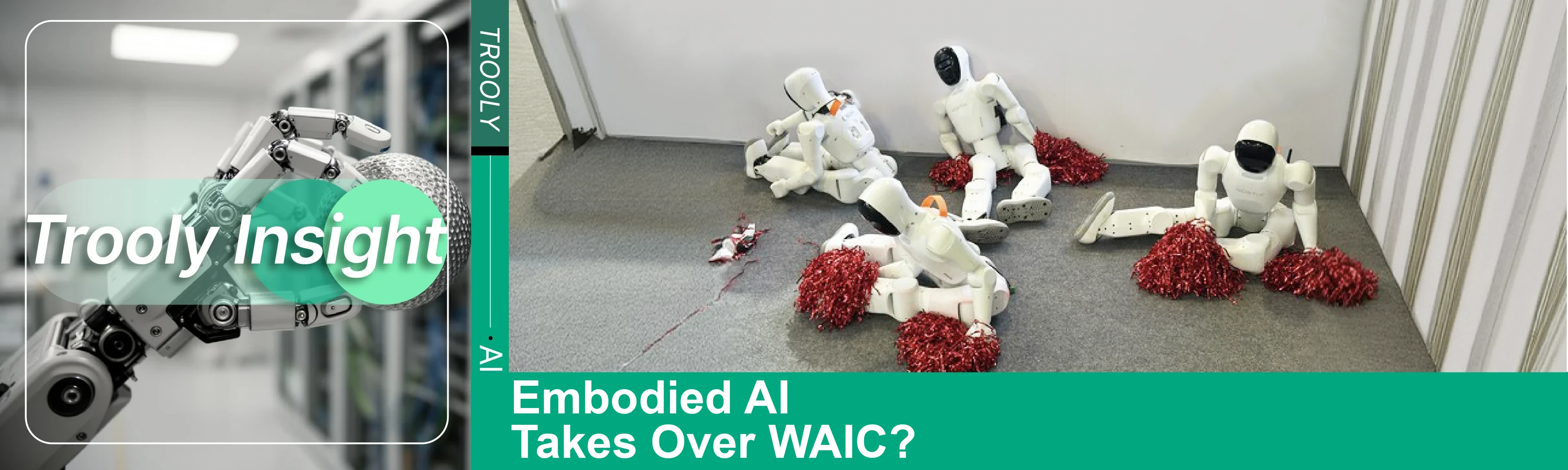
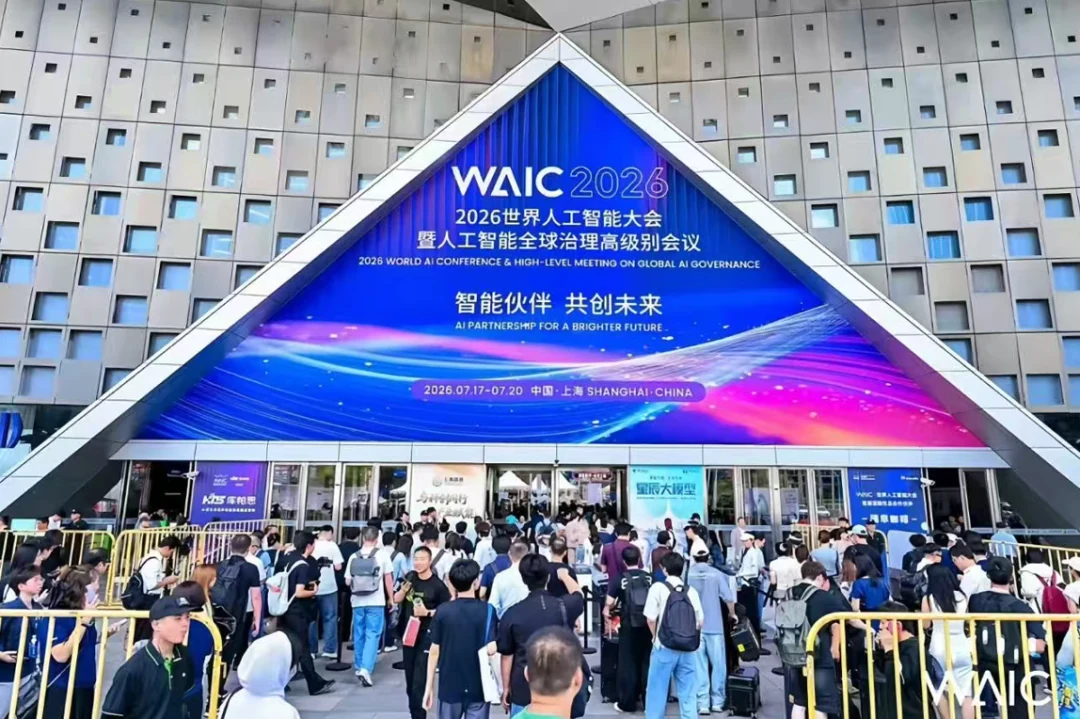
Shanghai in July: 39°C. Even hotter than the weather was the World Artificial Intelligence Conference (WAIC), which had just drawn to a close.
Single-day tickets originally priced at RMB 168 sold out within a week of release. On resale platforms, a one-day ticket climbed to RMB 1,500, while a three-day pass soared to RMB 3,000. People joked that getting a WAIC ticket was harder than getting a concert ticket.
But foot traffic was not the only thing heating up the venue. For the first time, this year's conference operated simultaneously across four halls in three areas—the World Expo site, Zhangjiang, and the West Bund. It was the largest WAIC ever: more than 1,100 companies competed on the same stage, showcasing over 4,000 exhibits, with 349 products making their global debut and attendance surpassing 400,000.
At a conference where every corner of AI was fiercely contested, Trooly AI made its debut, demonstrating how a 45-minute in-depth AI interview can uncover a brand's next answer for growth through the voices of real users.

The buzz spilled beyond the booth itself. The squishy eggs Trooly prepared became one of WAIC's “hidden hits.” More than 4,000 were handed out. Once visitors started squeezing them as they walked the show, they could not stop. The instinct to collect free eggs really must be in our DNA!

But while more than 1,100 companies flexed their muscles and showed off their technology, we cared more about the real voices beyond the booths. Here are a few of the things we heard and brought back from the WAIC floor.
At our booth, we set up a “WAIC Voice Recycling Station.” The rules were simple: company brochures became ballots. Drop one into the corresponding bin—vote “hot” if you thought a company was impressive, or “not” if you thought it missed the mark.
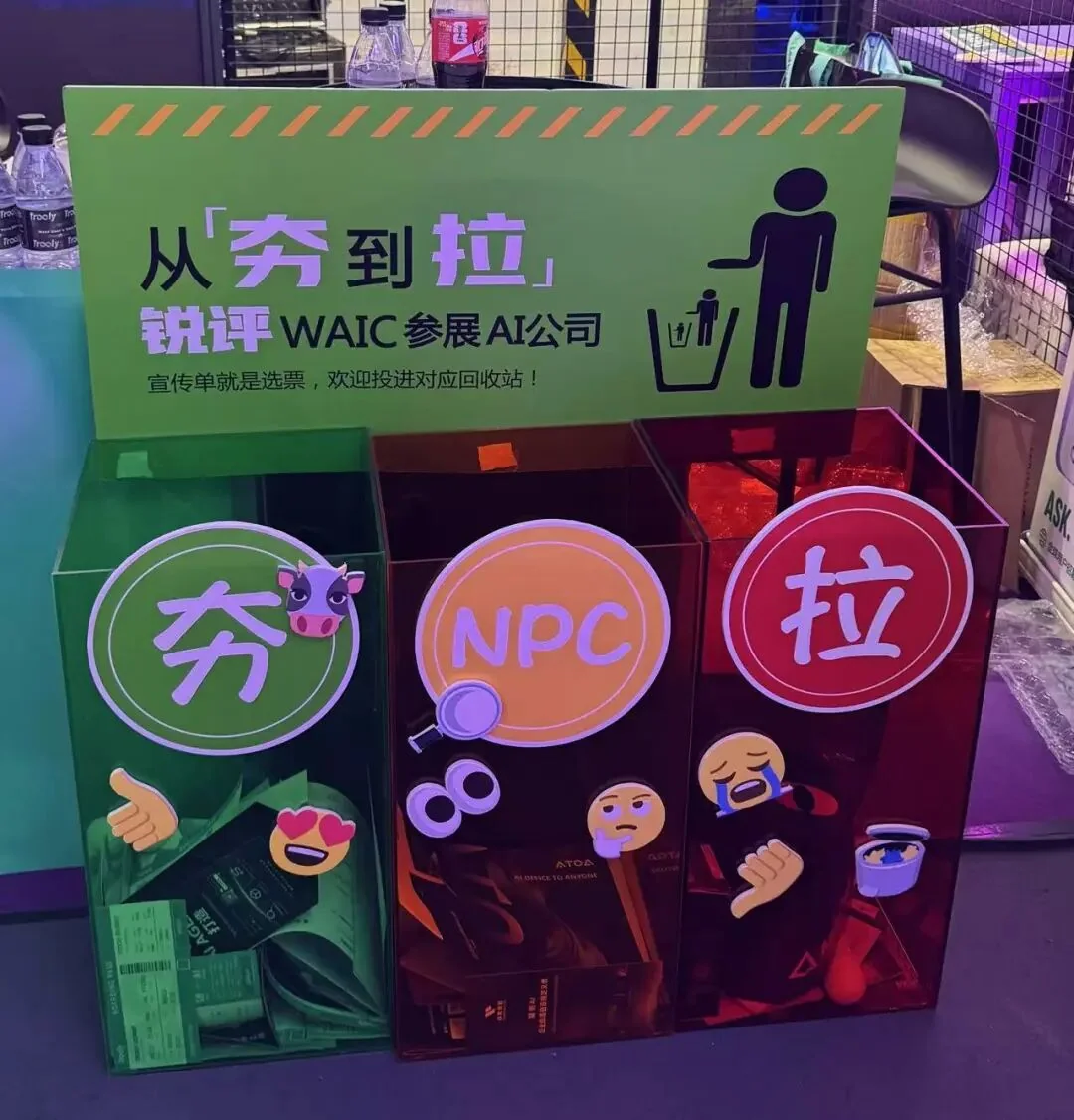
After four days, the bins were packed. We sorted through them and discovered that the category receiving the most votes was not foundation models and not compute chips, but embodied intelligence. Unitree, AgiBot, Deep Robotics—the same names appeared again and again.
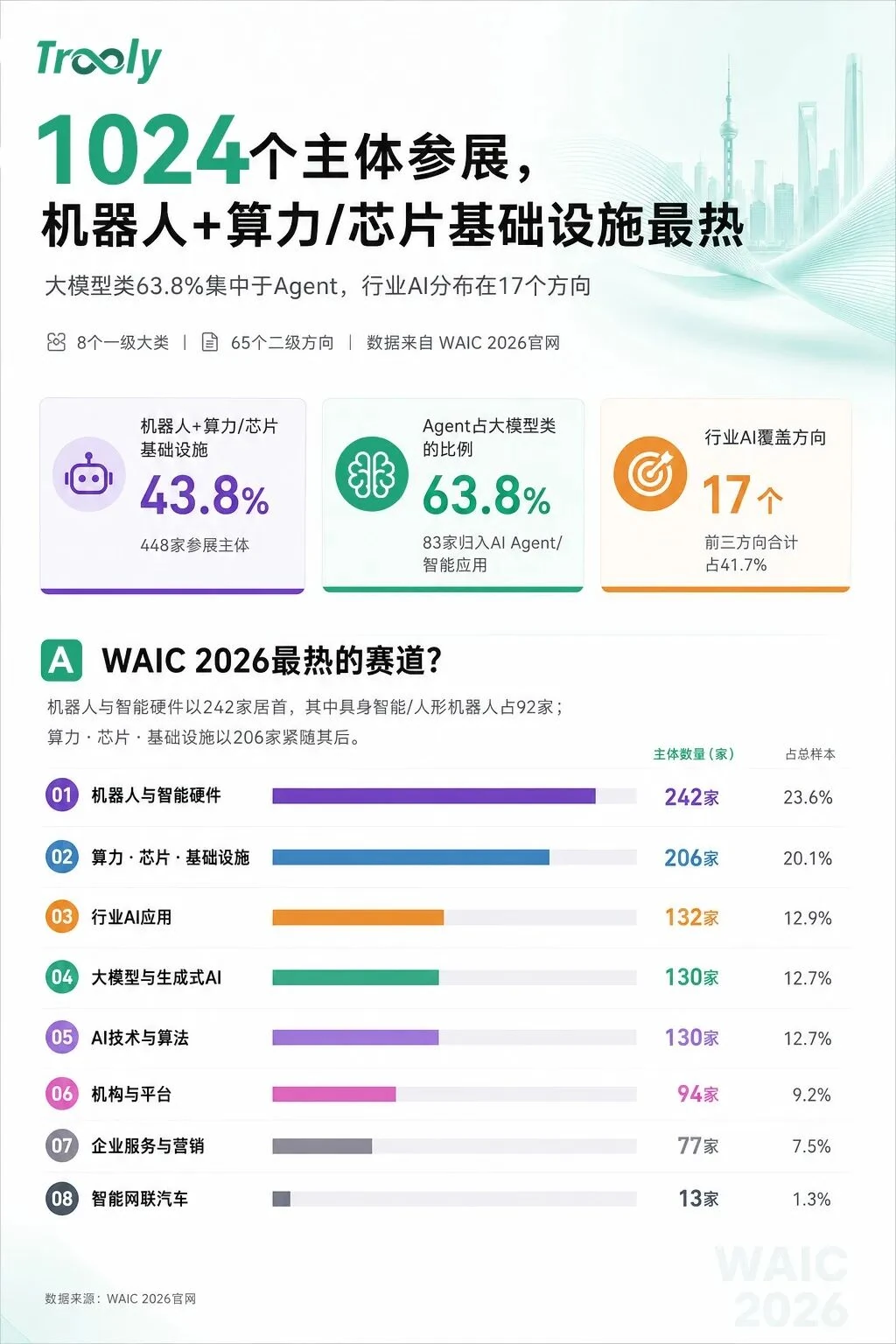
The signals extended beyond Trooly's booth, and the numbers told the same story. A total of 242 robotics and smart-hardware companies exhibited, accounting for 23.6% of all exhibitors and making the category WAIC 2026's hottest sector. Embodied intelligence and humanoid robots alone accounted for 92 companies. The number of exhibitors surged from more than 80 last year to over 200, with more than 300 physical robots on display.
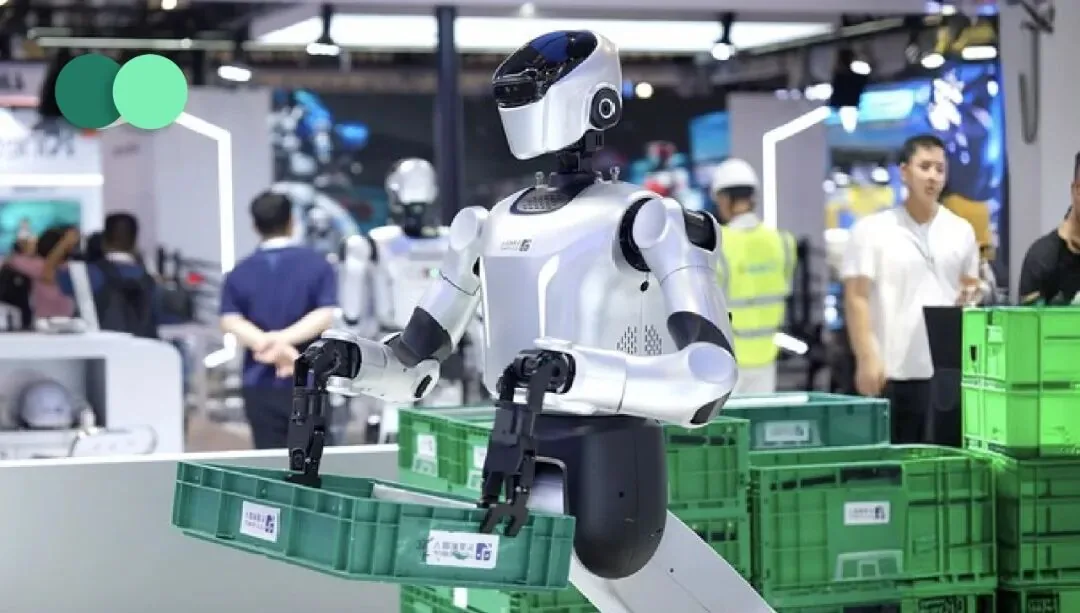

Unitree's giant mecha was the show's undisputed star. AgiBot recreated a real warehouse scenario featuring its Genie G2 Max in partnership with JD Logistics. Deep Robotics' DR02 performed military-style boxing drills and backflips with crisp precision. Hall H3 felt almost like a robotics convention in its own right. Its popularity was unmistakable, but the question worth asking is: where is embodied intelligence headed in the eyes of global users?
During WAIC, Trooly interviewed 50 users around the world who are interested in embodied intelligence. Across four days of conversations, three directions came up repeatedly. They are also the three hottest embodied-intelligence categories from a global perspective today.
Industrial and service settings: robots are starting work
This was the direction mentioned most often by respondents in Trooly's interviews, and it was also the biggest change in this year's embodied-intelligence exhibition area. Robots were no longer merely doing backflips, dancing, or practicing calligraphy. They were actually doing jobs.

The number of exhibitors in the embodied-intelligence area surged from more than 80 last year to over 200, bringing together 208 embodied-intelligence terminals and more than 300 physical robots. More importantly, nearly 60 humanoid robots provided wayfinding and guidance in public areas across the “three sites and four halls.” It was the first time a large exhibition in China had put humanoid robots to work at such scale. This was not staged for a photo; the robots were doing real jobs.

AgiBot co-founder Peng Zhihui put it plainly: “Embodied intelligence is moving from ‘showing what it can do’ to real deployment and productivity.” The real warehouse environment developed by the Genie G2 Max and JD Logistics was recreated on-site: robotic arms handled and stacked goods around the clock, each carrying loads of up to 18 kilograms—“no shift changes and no one supervising the night shift.” As industry media observed, “mass production, adaptation, and scenario delivery” replaced “walking, jumping, and flipping” as the central keywords in this year's embodied-intelligence area.
In Trooly's interviews, a German industrial-automation professional said, “The requirements of a German factory are simple: can it work continuously for eight hours without failing? That matters more than any backflip.” An American manufacturing buyer added, “I don't need it to look human. I need it to work in my factory. Whichever form factor gets the job done is the one I'll buy.”
Only when robots stop performing and actually start working does the commercialization of embodied intelligence take its first real step.
Home and companionship settings: robots are starting to move in
The clearest signal from this year's WAIC was the divergence of industry paths. Companies are no longer rushing en masse to build general-purpose humanoid robots; instead, they are pursuing different directions for different use cases. One path targets productivity, while the other focuses on the home, emphasizing emotional companionship and participation in everyday life.
Home use cases came up repeatedly in Trooly's interviews. When discussing embodied intelligence, many respondents spontaneously asked: “Is there anything that can help me with housework?” “Can it help an older person live independently?” Compared with a robotic arm moving goods in a factory, they were more interested in knowing when a robot could enter their living room. Gasgoo CEO Zhou Xiaoying was direct at WAIC: the path toward home robots is certainly right, but the technology is not ready. It is not yet time for humanoid robots to enter the home.
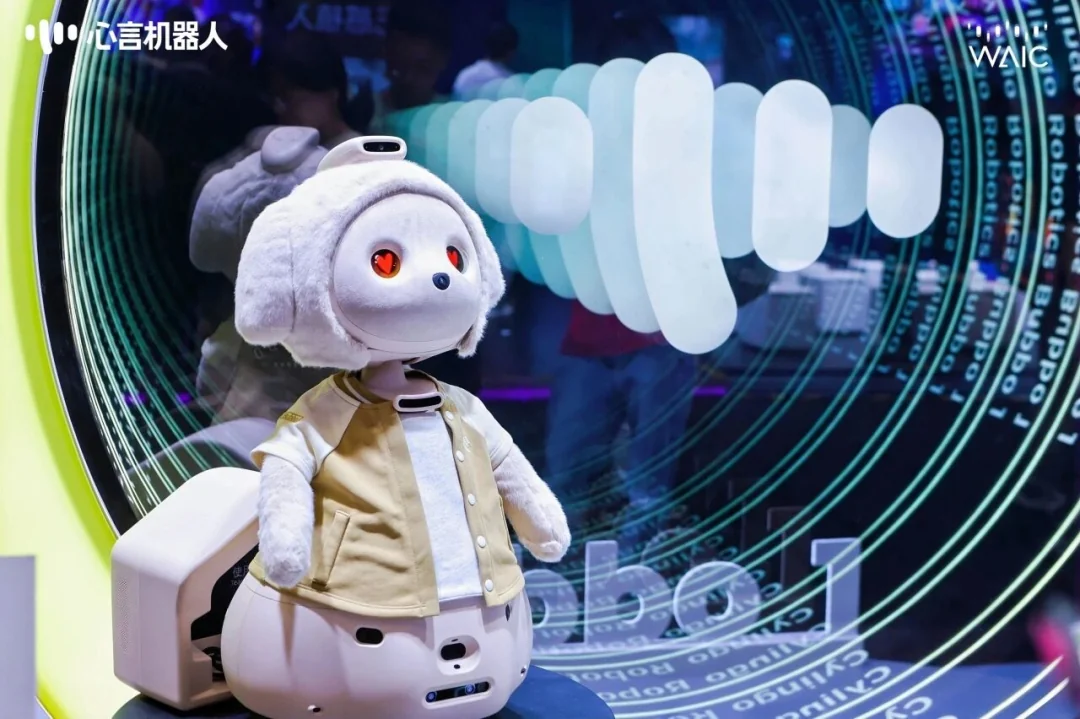
Fourier Intelligence unveiled its full-stack “Embodied Home” technology demo for the first time. Its flagship GR-3 model became an intelligent household assistant: say “I'm thirsty,” and the robot independently understands the need and brings you a drink. Visitors beside the desktop-size GR Nano repeatedly exclaimed, “So cute!” Bubbo, from Xinyan Robotics, took a different path. Standing about 65 centimeters tall, with a plush exterior and anthropomorphic design, it aims for “greater precision and stability” in emotional connection and conversational rhythm, and is scheduled for mass production by the end of the third quarter of 2026. Luming Robotics' booth proposed a progressive path: industry → business → home, representing three stages in embodied intelligence's evolution toward general intelligence.
But bringing robots into the home has not been a smooth journey. One scene at WAIC proved especially controversial. At the Moore Threads booth, a visitor holding a microphone asked the product manager directly: “You've put so much effort into building this thing—but where is the market? Where is the use case?” The product manager ultimately replied: “It's better than an alarm clock.”

The MTT AICUBE is priced at RMB 10,999—equivalent to ten premium robot vacuums. Its hardware specifications are extensive, but users do not know what concrete problem it solves. One commenter complained: “I'm spending more than ten thousand yuan on this, but I still have to tell it what I want done. Why not just tell myself?”
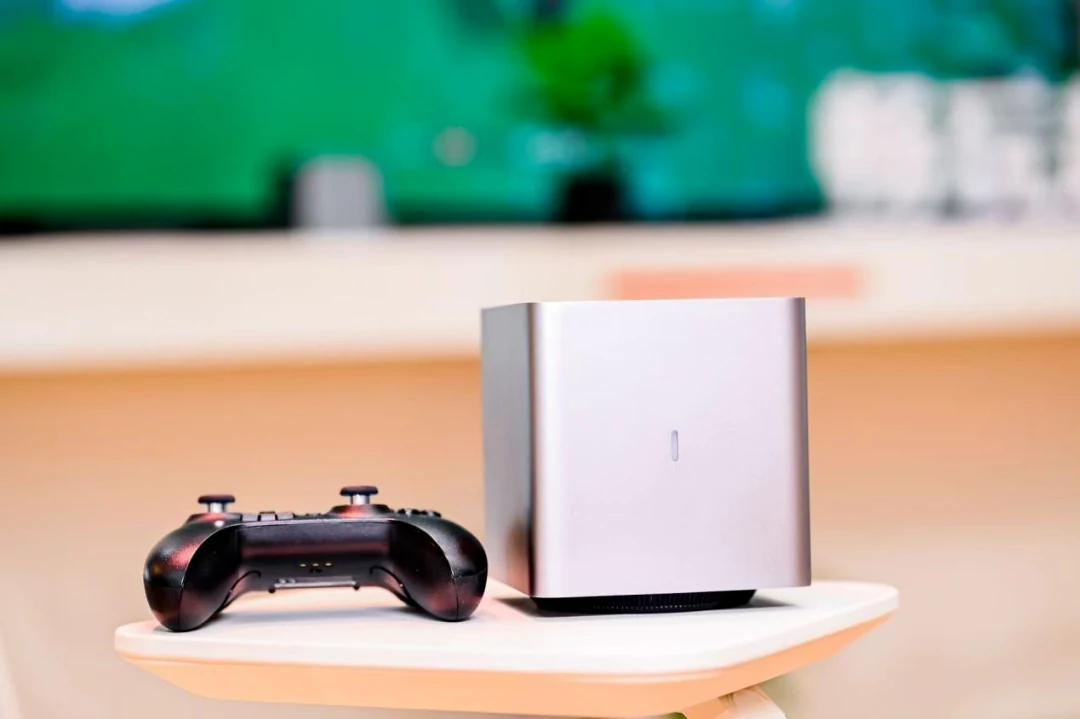
And just like that, “the RMB 10,000 AI alarm clock” became a meme. The anticipation is real, and so is the demand. But when users ask, “Where is the use case?”, they are reminding everyone that the road into the home is far harder than the road into the factory. Find the real need and the real scenario first, then talk about technology. That order cannot be reversed.
Data and models: competition for the “brain” begins with data
At this year's WAIC, the industry's center of gravity was shifting from a “body race” to a “brain race.” In the first half of 2026, financing in embodied intelligence reached RMB 93.5 billion, five times the amount a year earlier; RMB 14.5 billion of that flowed into “brain-first” companies. Investment logic is shifting from “betting on hardware form factors” to “betting on general intelligence.”
But training the “brain” is far more complex than it seems. Large language models have ready-made text from the internet. Autonomous-driving systems have millions of vehicles collecting data in real time. Embodied intelligence, however, operates in the physical world. Unscrewing a bottle cap alone produces multidimensional data involving vision, force, touch, wrist angle, and more. The total global supply of high-quality, real-world physical-interaction data is only about 500,000 hours. Yet industry consensus holds that embodied intelligence needs at least tens of millions of data points to reach its “GPT-2.0 moment”—a difference of two orders of magnitude.

AgiBot partner Yao Maoqing believes the physical world may require real data on the scale of “hundreds of millions of hours.” TARS AI founder Chen Yilun offered a more specific estimate: embodied manipulation requires at least 10 million hours of data, ten times the amount needed for autonomous driving. In Trooly's interviews, an embodied-intelligence founder from North America said, “What we lack isn't algorithms; it's data from real scenarios. A model can run perfectly in a lab and collapse the moment it enters the real world.”
At its WAIC booth, AgiBot defined 2026 as the first year of “deployment.” Built around its integrated three-intelligence architecture, the company showcased three foundational AI technologies: the GO-2 embodied foundation model, the GE-2 world model, and the Genie Evolver 1.0 reinforcement-learning system for physical robots. TARS AI's general-purpose embodied foundation model AWE won a WAIC SAIL Star, making it the only embodied-intelligence foundation model at this year's conference to receive the honor.
Models determine the starting point; data defines the endgame. Only when the industry's shared question shifts from “What can I do?” to “How should I learn?” does the real competition in embodied intelligence begin.
WAIC has ended, but the global race in embodied intelligence is only beginning. Moving beyond performance is becoming an industry consensus, as robots leave exhibition booths and enter factories, warehouses, and public spaces. The industrial and household paths are diverging at speed, and the race for the brain is already underway.
The first year of mass production has arrived. Hype and opportunity coexist; noise and composure intertwine. The debate around embodied intelligence will continue for a long time. Yet the brands that truly endure the cycle will not be the hardware companies with the most overloaded specifications, nor those with the grandest fundraising stories. They will be the brands that can read real needs, understand real scenarios, and continuously create verifiable value in the real world.
At this “Chinese-style inflection point,” the scarcest resources are not compute or chips, but real voices and market insight. Trooly ensures that real voices from around the world are always in the room.